The Story Behind the Name OMOYA
The name OMOYA comes from the Japanese word omoya (母屋).
For many people, this may be the first time hearing the word.
Traditionally, an omoya is the main house of a property, distinct from storehouses, barns, or detached buildings.
It is the central place where family life unfolds.In architectural and legal contexts, the same concept is sometimes written with different characters.
What drew me most, however, was the character 母, meaning mother.
Why did the Japanese choose the character for “mother” rather than “father” to describe the heart of a home?I found myself reflecting on that question.
No matter our gender, nationality, or background, there is one thing we all share.
Every one of us began life in our mother's womb.
Perhaps the womb is our very first home.
A place of complete safety, warmth, and belonging.
I sometimes imagine that the people who first used the word omoya wished for a home that could offer that same sense of comfort and protection.
That may be why they chose the character for “mother.”
Whether or not that is the true origin of the word, it is the meaning I have come to associate with it.
In the same way, I hope this house can be a place where visitors naturally let go of tension, take a deep breath, and feel as though they have come home.
A Living Room Inspired by the Womb
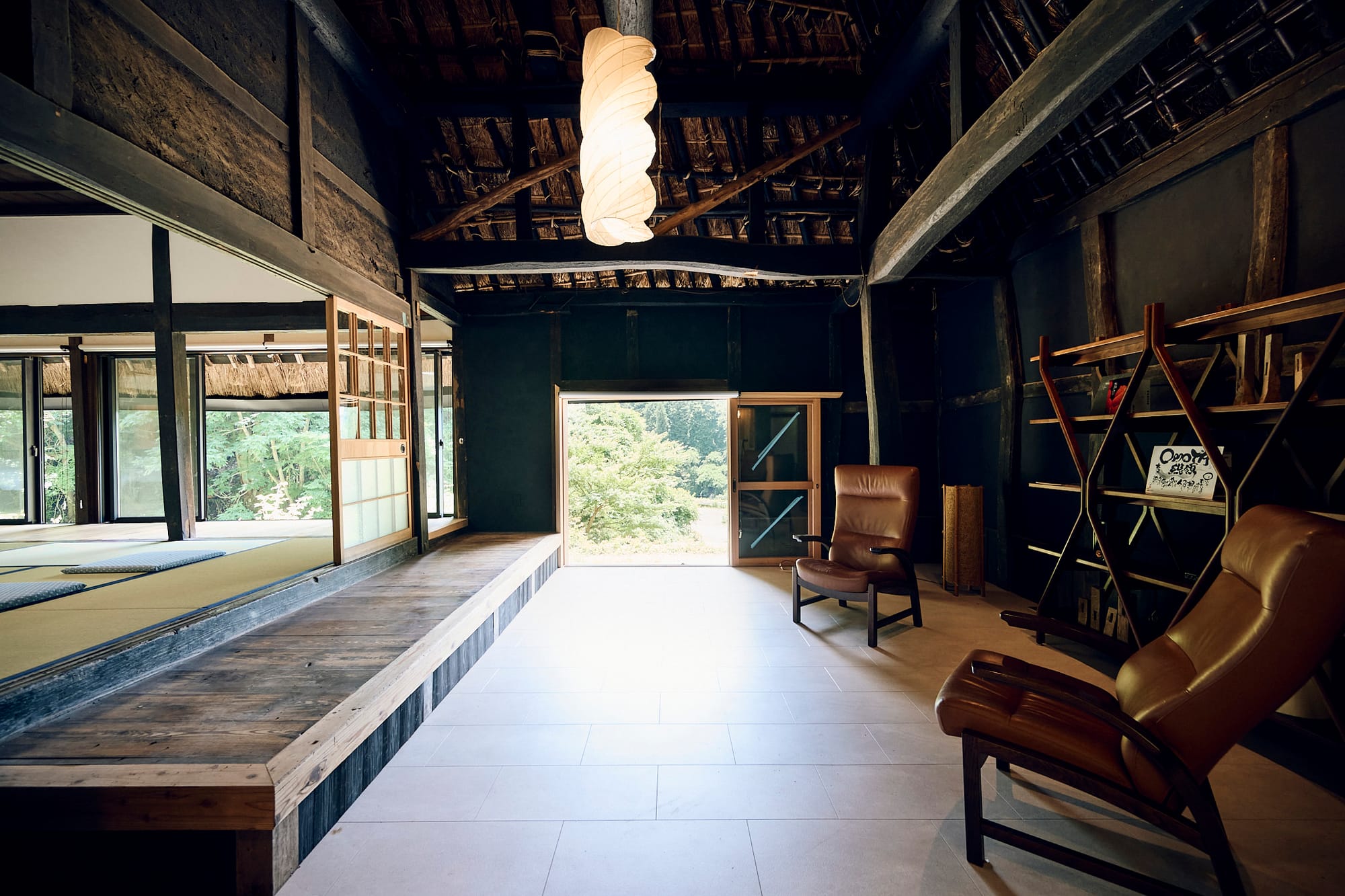
The triple-height living room at OMOYA Soryo was designed with the image of a mother's womb in mind.
The pillars, beams, and timbers have supported this house for more than three hundred years.
Their presence feels almost maternal, quietly holding the space together.
At the center hangs Nahwa, a light sculpture designed by the late environmental artist Mariyo Yagi. The piece was inspired by her philosophy of Nawalogy, which explores the idea that all things move in spirals.
Its form resembles an umbilical cord connecting mother and child, gently suspended within the room.
My connection with Mariyo Yagi began eighteen years ago.
Nahwa was personally gifted to OMOYA Soryo by the artist herself.
To me, it quietly connects the memories and stories held within this house with the passage of time that continues from past to present.
A Window Open to the World
The cross-shaped window in the living room was inspired by the home of Mexican architect Luis Barragán.
Only later did I learn that Mariyo Yagi had visited the house in the 1970s.
When fully opened, the window becomes a threshold between inside and outside, a gateway to the wider world.
Here, one can pause for a moment.
Rest.
Regain strength.
And then return once again to one's own world.
There is something about that experience that feels like being born anew.
Why I Chose the Name OMOYA Soryo
Omoya is a uniquely Japanese word.
Yet I believe everyone seeks a place where they can feel safe, at ease, and at home.
That is why I chose to keep the name OMOYA in Roman letters.
I wanted to share the word itself, along with the sense of comfort, belonging, and home that it carries in Japanese.
I also chose to include Soryo, the name of this land.
This is the house where my father was born and raised, and for me it represents the roots of life itself.
The fact that this place still exists today is thanks in part to the people of Soryo, who have cared for and protected this land across generations.
I hope to share not only the name Soryo with the world, but also the history, memories, and spirit of this land.
I hope that those who spend time here will carry a memory of Soryo with them, and perhaps one day think of this place again.OMOYA opens outward to the world.
Soryo keeps it rooted in this land.
With those thoughts in mind, I named this place OMOYA Soryo.